

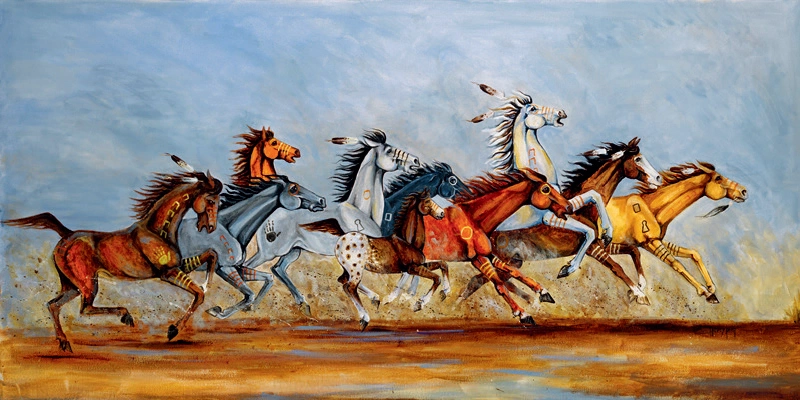
by Carol Mowdy Bond
Juliet M. Getty, Ph.D., is an internationally respected equine nutritionist, author, consultant, and speaker. I asked Getty some questions.
What type of forage is best for horses and should it be available free choice? Answer: The horse’s digestive tract is designed to have a steady flow of forage going through it at all times. There are many reasons for this. The stomach continually produces acid, and the horse needs to chew to produce saliva, a natural antacid. With
nothing to chew, the unprotected squamous region of the stomach will develop ulcers. But even the lower, glandular region can be affected, as an empty stomach loosens the pyloric sphincter at the base of the stomach, promoting the reflux of acid-containing predigested material from the duodenum back into the base of the stomach. Farther down the digestive tract, the cecum, a large fermentation vat where billions of microbes digest fibers, needs to be full in order for its contents to exit at the top. Without enough to eat, material can remain in the cecum, potentially leading to colic.
From a psychological perspective, not having a steady flow of forage tells the horse that “winter is coming,” and he will naturally become insulin resistant in an attempt to store body fat. We duplicate this scenario that naturally occurs in the wild when we restrict forage and put the horse at risk of developing laminitis. But when forage is available at all times, this response is calmed, and the horse can maintain a normal body condition.
Fresh pasture is the most nutritious source of forage, but if the horse is already overweight or insulin resistant, it might be too risky. However, hay must be provided in its place. Hay should be tested and should be low in sugars and starch to minimize the elevation of insulin (ethanol soluble carbohydrate [ESC] plus starch should ideally be no more than 10 percent). Feeds also need to be free of cereal grains and sugar (typically from molasses). Essentially, the horse needs to be able to chew forage at will, and any concentrates need to be free of insulin-raising ingredients.
What’s the best way to ensure that all of your horse’s vitamin and mineral needs are being met?
Answer: Healthy, growing pasture grasses are generally nutritious enough that additional supplementation is not required. But once that grass is cut, dried, and stored, it loses many key nutrients. One nutrient that I find many people neglect is essential fatty acids. There are two. One is omega-3 – alpha-linolenic acid (ALA). The other is omega-6 – linolenic acid
(LA). Pasture grasses typically offer these two in a 4:1 ratio of ALA:LA. However, if your horse gets fat from a commercial feed that uses “vegetable oil” or “soybean oil,” he is getting way too much LA, which increases inflammation. It is important, therefore, to supplement ground flaxseeds or chia seeds to provide enough ALA in the proper proportion to LA.Other nutrients missing from hay include vitamins A, E, and perhaps D (if the hay is many months old). Even B vitamins
“The horse was and still is an important animal of our indigenous cultural lifeways,” says Gordon Yellowman.
“The horse provided us transportation for traveling and the ability to hunt and run next to the buffalo. We rode the horse in conflicts with traditional enemies and cavalry soldiers.”
“Horses changed the culture for the Plains Indian people, and they not only owned horses, but they had special horses that they used in war, in hunting buffalo,” says Harvey Pratt. “They recognized the talent of horses and were close to horses because of the personality of the horse.”
Oklahomans Yellowman and Pratt are members of the Cheyenne and Arapaho Tribes of Oklahoma and are acclaimed artists with innumerable awards who include horses in their art. Pratt received the title Master Artist Honored One, one of the Native American art community’s highest honors, during the 2005 Red Earth Native American Cultural Festival. Yellowman received the same honor in 2010.
Yellowman and Pratt are highly honored members of the Council of Forty-Four Cheyenne Peace Chiefs, with Yellowman having been chosen at age 16. Both men have extensive, highly respected knowledge
bases and honored family ancestries. In addition, they have prestigious accolades and careers, and Pratt was inducted into the Oklahoma Hall of Fame in 2021.
Predicting the Horse
Yellowman explains that long ago, Sweet Medicine, Motséeontse (sweetgrass), the legendary Cheyenne prophet and cultural hero, predicted the coming of the horse:
“There will be an animal you must learn to use. It has a shaggy neck and a tail almost touching the ground. Its hooves are round.


This animal will carry you on his back and help you in many ways. Those far hills that seem only a blue vision in the distance take many days to reach now, but with this animal, you can get there in a short time, so fear it not. Remember what I have said.”
Indigenous histories do not fit neatly into Euro-American categories. For example, an indigenous group that a nonindigenous group has labeled as a Plains tribe might have ancestral homelands in subarctic forests of Canada. But migration patterns and forced removals caused the group to relocate. Such is the case with the Cheyenne and Arapaho tribes, which are now considered Plains tribes.
The Cheyenne and Arapaho tribes originally lived in the Great Lakes region. It is difficult to say when, but they might have merged as a unified group in the eighteenth or early nineteenth century. Today, the headquarters of the Cheyenne and Arapaho Tribes of Oklahoma is in Concho, and both nations are listed among the Plains Horse Nations.
The Cheyenne, or Tsistsistas — meaning
“human beings,” or “the people,” — descend from an ancient tribe referred to as Chaa. During the late seventeenth century, the tribe settled on the border between Minnesota and the Dakotas. The Cheyenne tribe became a powerful Plains Indian
nation when they mastered horses, likely between about 1700 and about 1825.
In about 1680, the Hinono’ei, which means “people” in the Arapaho language, began to migrate out of their area because of Europeans and traditional enemy tribes and later because of forced removal by Americans. When horses and buffalo flourished, the whites referred to the Arapaho tribe as horse-using Plains people. With their pony herd of 4,000, they were hunting along Wolf Creek in what is now northwestern Oklahoma by 1885.
Pratt says, “Tribes realized there was a pattern there among horses that they could utilize, and it was almost like therapy for them to have horses. It wasn’t just a matter of having a horse, but horses had all kinds of abilities that helped the people survive.”

Horses in North America
Some scholars believe horses arrived in North America millions of years ago but disappeared across the Bering Strait land bridge about 10,000 years ago. Other scholars claim horses were never extinct and were used by indigenous tribes prior to Christopher Columbus’ arrival. Still others say that when Columbus brought two dozen Andalusian horses (pure Spanish horses from the Iberian Peninsula) on his second voyage to the New World in 1493, a radical lifestyle shift began for indigenous groups. That shift heightened when other European explorers also brought horses to the continent.
Then instead of traveling by foot and using dogs as pack animals, indigenous people relied on the swift movement and strength of horses. As indicators of wealth, horses transformed every aspect of tribal lives and societies. Tribes in different areas of the present United States accessed horses through various means. The Five Nations (Five Tribes) acquired them from Spanish explorers who came into their homelands in the Southeast along the Gulf of Mexico.

Tribal Horse Events Today
Numerous tribes have integrated horses into their histories and culture. Many tribal members ride and raise horses today, and some participate in competitions.
The Indian National Finals Rodeo (INFR) tours include a competition in Okmulgee in June. The finals will be in Las Vegas, Nevada, in October 2024.
For indigenous nations and horses, the past, present, and future collide with
“Indian relay” — literally. Sheridan, Wyoming, hosts the Sheridan WYO Rodeo in
July with the Professional Rodeo and 2024
World Championship Indian Relay Races. Relay race teams, each composed of a rider, three horses, and team members, compete for $90,000 in cash.
An organized sport beginning in the early twentieth century, the Indian relay originated with horse-stealing raids against other tribes and white settlers. Tagged as
“America’s original extreme sport,” the competition features bareback racing with no stirrups and no protective gear. Although injuries are part of the sport when racers collide with thousand-pound horses, the race connects to pride, to Indian warriors of the past, and to the history of the continent’s first people.


