by Anna Holton-Dean
For Edmond artist and horse trainer Jennifer Cocoma Hustis, art and horsemanship have always been two sides of the same coin — both requiring presence, patience and the courage to listen and communicate without words. As founder of Art of Horsemanship LLC, Hustis has built a unique space where students learn not only how to ride but also how to observe and create through various artistic mediums.
From an early age, Hustis felt a connection to horses.
“When I was 2, my family moved to Oklahoma, to a neighborhood where the lots were a couple to five acres, and many homes had horses grazing in their pastures,” Hustis says. “I didn’t have a horse of my own, but that didn’t stop me. I’d sit by the roadside, notebook in hand, sketching their silhouettes and scribbling stories, trying to capture the mystery of their movements.”
Despite the fact that she spent much of her childhood “on the ‘wrong’ side of the fence,” it never felt that way to the horse lover.
“That space became my sanctuary, my studio, my first classroom in the language of horses,” she says. “I can’t remember a time I didn’t love these majestic animals. It’s as if horses were part of my DNA.”
Today, Hustis is known for her expressive paintings, prints, drawings, sculptures, and photography of horses and wildlife — artwork that explores the idea of animals as messengers.
A graduate of Pratt Institute in New York, she exhibits in galleries and museums across the country and abroad, and her work is represented by Terra Rosa Art Gallery in Guthrie. She’s also a member of the Cowgirl Artists of America and a published author of children’s books that blend art, stories and lessons from life with animals.
For Hustis, art and horsemanship have never been separate callings though art took shape first. “My mother was an artist, and while she didn’t know much about horses, she always made sure I had plenty of art supplies,” she says. “Art became my first language. It was a way to express emotions.
Her deeper understanding of horses came later, after studying equine behavior and training across disciplines.
“I discovered what my heart had known all along: there are science-based links between horses and humans, especially those of us who think with our right brains,” Hustis says. “Horses are right-brain dominant. They are sensitive, intuitive and holistic in how they perceive the world. Artists are the same. We feel first, then interpret.”
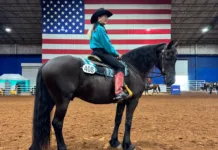
Today, her competitive riding record is just as impressive as her artistic resume. In 2018, Hustis and her Spanish Mustang placed in the top 10 nationally in Working Equitation and at the Western Dressage World Championships. In 2022, they earned WDAA World Reserve Champion in Musical Dressage, followed by World Reserve Champion in Horsemanship in 2023.
Beyond the arena, Hustis continues to curate interactive art exhibits that merge education, storytelling and hands-on experience. Her most recent curation was the “Punchy Western Art Invitational: A Celebration of Oklahoma’s Creative Grit,” displayed at The Goddard Center in Ardmore.
“After spending the time it takes to curate or create an interactive exhibit, I love seeing the public engage with the art exhibition and having it resonate with all ages,” she says. “Often, the exhibit ends up staying on display longer than expected due to the positive response.

“When I create a museum or gallery exhibit, my goal is to make learning feel like a curious encounter for all ages. I design each space to invite curiosity, layering visual storytelling with interactive elements that encourage viewers to explore, feel and connect. My own quiet, inquisitive nature as a child still guides me: I want each person to leave with a sense of wonder and a desire to learn more.”

Through these exhibits, Hustis hopes to bridge the gap between people and the animals she’s always felt so close to. “Much of my work centers on advocating for horses whose language is often misunderstood,” she says. “Through art and education, I help translate equine behavior into something people can see, feel and begin to understand.”
Her creative process always begins with a feeling, a memory or a dream often sparked by time spent in nature or on horseback, she shares. “I do not always know where a series of art is leading when I begin, but over time, its meaning reveals itself. My work is guided by intuition, spirit, and of course, the horse.”
For Hustis, whether she’s curating a museum exhibit, helping a student learn to trot or painting a wild mustang from memory, it all stems from the same impulse — to understand the horse, guide students with care and bring her observations to life through art.