by Ashley Daily
Since the American Society for the Prevention of Cruelty to Animals (ASPCA) introduced Adopt a Horse Month in 2021, it has helped to spread awareness about equine adoption, resulting in thousands of rescued equines finding forever homes. Shelters that participate in the campaign, held each May, report an average adoption increase of 43 percent during that month.
Equine adoption has never been as common as dog and cat adoption, but more people are adopting equine family members because of Adopt a Horse Month and events such as the ASPCA Right Horse Adoption Affaire, held during Equine Affaire.
Misconceptions about rescued equines still circulate, however, such as the idea that many rescued equines have behavioral or health issues. Cheri White Owl of Horse Feathers Equine Center in Guthrie points out that this is an unwarranted concern.
“All of our horses go through an evaluation when they arrive. We’re very open with people. If we have a horse that has a medical condition and can’t be ridden per se and they just want a companion horse, we let them know so they can do that. They can still have a great horse even if it’s just an animal they can love and pet and groom.”
Horse Feathers is a 501(c)(3) nonprofit organization committed to assisting neglected and slaughter-bound equines. White Owl says the number of horses, donkeys, and mules that the center takes in can vary, ranging from six per year to as many as 15 if a cruelty case is involved.
Not all equines at Horse Feathers come from a background of abuse and neglect. Some horses arrive at shelters as the result of owner surrender, when an owner gives up custody of animals because of no longer being able to physically or financially care for them. Some horses even have registration papers.
Research and Training
One plus of adopting a horse versus buying one is that adopters know exactly what they are getting, and staff members work diligently to ensure that a horse and human make a good match. However, White Owl advises that adoption shouldn’t be an impulsive decision. She says the biggest problem she runs into is people who don’t know how to properly care for horses.
“Do your research,” she says, “such as number one, where you’re adopting from, and number two, the animal you’re considering. Spend some time. Whether it’s volunteering or taking classes, do whatever it takes to learn proper care before you get headlong into it.”
Off-track thoroughbreds (OTTB) have
become increasingly popular. “Most of these horses are fantastic athletes, and they can go in so many different directions,” says Nelda Kettles, who runs Horse and Hound Rescue Foundation (HHRF) in Guthrie. “They can be trail horses or jumping horses and do dressage.” Some OTTBs have even been known to excel in western sports such as barrel racing.
HHRF is a nonprofit organization that takes in OTTBs straight from tracks and trainers, retraining them to become suitable for everyday riding. Kettles adds that horses that come from the track with significant injuries are given sanctuary at HHRF for the rest of their lives. When horses arrive at HHRF, they are given plenty of time to rest and forget about their time on the track and then enter training at an individual pace for each horse.
Since opening in 2016, HHRF has adopted out 600 horses, averaging about 50 adoptions per year. People from all over the country have adopted from HHRF. For out-of-state adopters, HHRF provides videos of the horses being considered, and an uptick in adoptions occurs during Adopt a Horse Month because of adoptable horses being viewed on social media.
Like Horse Feathers, HHRF will take back horses if circumstances change. “If the horse does not work out for any reason, it can always come back here,” says Kettles. “We always want the horse to be safe.”
An Adoption Success Story
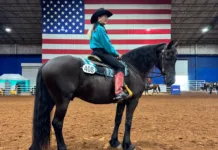
Cindy Anderson and her husband, Leroy, have adopted several horses from HHRF, including a 16-hand gelding named Euro whom they adopted in 2018. “I have seen him grow from a timid and nervous horse straight from the track into the incredibly kind and gentle horse I knew he could become with the right hand and patience,” says Ms. Anderson. “He is essentially now a big baby that I love so much.”
Today, Euro enjoys working cattle and showing in ranch pleasure competition and is a trustworthy bareback mount. “When he is grazing out in the field and sees me, he will come trotting right over to meet me, which shows how strong a bond we have built since I brought him home,” she says.
How To Adopt or Help Out
Horses available from HHRF and other equines from around the country can be found on ASPCA’s My Right Horse extension, an online database that gathers information about hundreds of adoptable equines in one place.
The federal Bureau of Land Management (BLM) also gives people the opportunity to adopt wild horses and burros at adoption events in person or online. Oklahoma has an off-range BLM facility in Pauls Valley, with adoptions on the second Tuesday of each month.
Are you interested in helping equines in need but are not ready to adopt? Shelters always appreciate donations for feed and veterinary care and volunteers to muck, groom, and exercise horses.
Equine adoption is a win-win for everyone. The adopter gains a companion, the horse gets a loving home, and space is opened up at a shelter to help another horse find a fresh start.