by Casie Bazay
At the tender age of three, Madison Schalla decided she wanted to be a trick rider. She was attending a rodeo in Pagosa Springs, Colorado, in which her father was competing, and she saw a trick-riding performance for the first time. It wasn’t a passing phase; when she kept asking about it, Schalla’s mother decided to put her in lessons at age eight. Schalla’s parents drove her on a 90-minute round trip each week while she learned the literal tricks of the trade from renowned trick rider Dusta Kimzey. The lessons led Schalla to become more enamored of the sport, and she attended Red Top Ranch Trick Riding School in Colorado for three consecutive years. Today, at age 20, this native of Arapaho, Oklahoma, has been working as a trick rider for 12 years, and 2024 will be her second year as a Professional Rodeo Cow-boys Association (PRCA) specialty act.
Schalla’s Trick Horses
Trick riding not only involves a skilled and talented rider but also an equally skilled and experienced horse that must be both athletic and unflappable. As one might imagine, training a horse to perform trick riding isn’t an easy feat, and not every horse is suitable for that type of performance.
Schalla has two main horses that she uses specifically for trick riding, Trixie and Bowie. Both came from her grandfather, who had used them for elk hunting. As it so happens, elk hunting seems to build a perfect foundation for a trick horse.
“You usually want your horses to be broke enough to let you hang on while running in a circle around the arena,” said Schalla. “Some horses take longer [to train] than others, but the ones I’ve gotten from my grandpa have been the easiest because they have had elk hung on them, so they know how to hold weight on their sides.” As for the time it takes to train a horse for trick riding, Schalla says it varies from horse to horse. For example, it took her about six months to train Trixie, mainly because they were both still new to trick riding. When she acquired Bowie, it took only two weeks before she felt comfortable enough to perform trick riding with him.
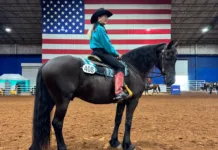
Along with trick riding, Schalla also competes in barrel racing. Although she notes that
barrel horses are typically a little higher strung than those needed for trick riding, she does
have a barrel horse named George that she occasionally uses as a backup for trick riding.
A Tricky Progression
Schalla says there are foundation tricks that every trick rider must learn first; all other tricks are based on the foundation tricks. To learn new tricks, she begins by doing them on her horse at a standstill. After that, she moves to a walk, a trot, and then eventually, a lope. “I’ve had some pretty great opportunities to learn my foundation from some of the best in the business,” said Schalla. “I’ve gotten to learn from the newer generation of trick riders and also from what we call the trick-riding legends.” Two of the standard tricks that Schalla performs are the shoulder stand, basically a handstand on the horse’s shoulder, and the death drag, in which the rider hangs upside down off the side of the horse and drags both hands in the dirt. The trick that took Schalla the longest to learn is the Stroud layout, in which the rider essentially “stands” off the side of the horse at almost a 90-degree angle. It is named for Leonard Stroud, a Wild West performer who originated the maneuver.
Schalla says that particular trick takes a great amount of core strength and is one of
the more difficult tricks to master. Schalla’s signature trick, however, is called “under the neck” — a trick that very few people in the United States perform because it is so complicated and dangerous.

Memorable Experiences
Schalla has performed at many rodeos during the years, but one of her favorite
things is to perform for a crowd that has never seen anything like what she does. She also enjoys talking to kids and signing autographs after her performances.
One of her most memorable experiences was performing at the PRCA rodeo in Burwell, Nebraska, with Shyla, Layna, and Clara Navarre, young trick-riding sisters from Weatherford, Oklahoma.
“I got to trick-ride going down the race-track,” said Schalla. “This made my horses run 10 times faster than they usually do.
I am also one of the only trick riders that have ever gone under the neck flying down a racetrack at those speeds.”
Some of Schalla’s other memorable experiences include doing Wild West shows in California and performing in front of Reba McEntire last summer in Saratoga, Wyoming.
The Difficulties of Trick Riding
Many people might not know that trick riding was once a competitive rodeo event.
However, that ended in the late 1940s when it was deemed too dangerous. Nowadays,
trick riders are specialty acts at rodeos, and many also work in Hollywood, doing stunts
for movies and television.
“We crash and burn all the time in practice because we are learning new tricks all the time,” said Schalla. Mishaps also occasionally occur at performances. “I was at a performance once when I went under the neck and my foot popped out of the stirrup, and I got run over,” noted
Schalla. “But I popped back up and finished my performance.” Trick riding gives new meaning to the phrase (and Chris LeDoux song), “Get back on that pony and ride.” Trick riders such as
Schalla simply get back in the saddle and keep chasing their dreams.
Interestingly enough, however, Schalla says the most challenging part of what she
does isn’t the riding itself but trying to book rodeo performances.
“You are in an industry where there are 10 other acts doing the same thing you are and bidding a price lower than you can,” she noted. “This is why I always have a goal of learning two new tricks every year so that I’m always evolving and getting better rather than staying at the same level.”
Passing the Torch
Schalla’s passion for trick riding includes passing the torch and teaching the skills she has mastered to the younger generation or anyone with a desire to learn. She has two students who are aged five and seven. The girls started with Schalla last fall, and they should be ready to perform at some local amateur rodeos by next summer, Schalla said.

As for Schalla’s advice to anyone wanting to learn trick riding, she says, “Find someone with at least 10 years of trick-riding experience who is a professional (PRCA). I would also find a school like the Red Top Ranch Trick Riding School or find someone who has been everywhere and
learned everything.”
Schalla books many of her performances at the PRCA convention held every December in Las Vegas, but she books others at the last minute. If your community would like to book a rodeo
performance with her, Schalla can be reached at [email protected].
You can also follow her on Facebook (@MadisonSchallatrickriding) and TikTok (@madison_trickriding).