by Rowena Mills
I was driving along one day this past spring, halfway listening to classical music on my car radio, when something suddenly caught my ear. The announcer was talking about Justin Morgan, founder of the Morgan horse breed, in connection with a musical composition. I thought, “What? What have I missed?”
It turns out that Justin Morgan (1747–1798) not only founded the first distinctively American breed of horses but also wrote some striking examples of the first generation of distinctively American classical music.
Many facts of Morgan’s life, even his birthdate, have become muddled since people started to write about him in the mid-nineteenth century. But vital records of Springfield, Massachusetts, show that he was born on February 28, 1747, and he was baptized on March 29. He was the eighth of 11 children of Isaac and Thankfull Morgan. Morgan’s mother died when he was almost nine years old.
Morgan married his first cousin Martha Day in late 1774, the year West Springfield was incorporated as a separate town and shortly before the beginning of the Revolutionary War. The couple had six daughters and one son. Two of the daughters died as young children.
A Varied Career
Although Morgan has been described as a “frail schoolmaster,” he considered farming to be his main occupation throughout his life. Starting in 1778, he also maintained a stable at which mares could be bred to various stallions that he cared for and managed. In 1781, he was licensed to keep an inn at Springfield but had only a retail liquor license at his house in West Springfield. He renewed the liquor license every year through 1785.
Morgan was also a “singing master” who sometimes taught singing classes — probably mostly to adults — and possibly also writing classes and “common school” (the free public education system had not been developed yet), but he was not primarily a “schoolmaster.”
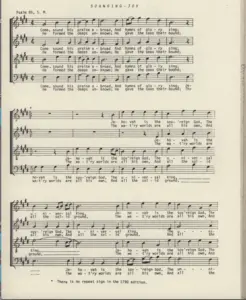
Throughout all this activity, Morgan found time to compose music. He was among several early American composers who produced “fuguing tunes” and other music — mostly for church use — in the later colonial and early federal eras (the best known was William Billings). The compositions, which had innovative harmonies and vigorous melodies, differed significantly from European musical style.
It is not known how many compositions Morgan wrote, but nine have survived and have been in print since the early 1790s. Eight of the nine are sacred vocal music. Morgan’s anthem “Judgment Day” was probably the most popular anthem sung in New England churches in the 1790s.
Morgan carried out all these varied employment activities under rather adverse financial conditions — he was never wealthy and sometimes did not even have land of his own despite his primary occupation.
The Acquisition of Figure
In 1788, Morgan and his family moved to Vermont, settling near Randolph, where some of his relatives lived. He served as town clerk for a time. Morgan’s wife, Martha Day Morgan, died in Randolph on March 20, 1791, only 10 days after the birth of her seventh child. Struggling to take care of his young family after their mother’s death, Morgan eventually placed some of his children in the homes of friends.
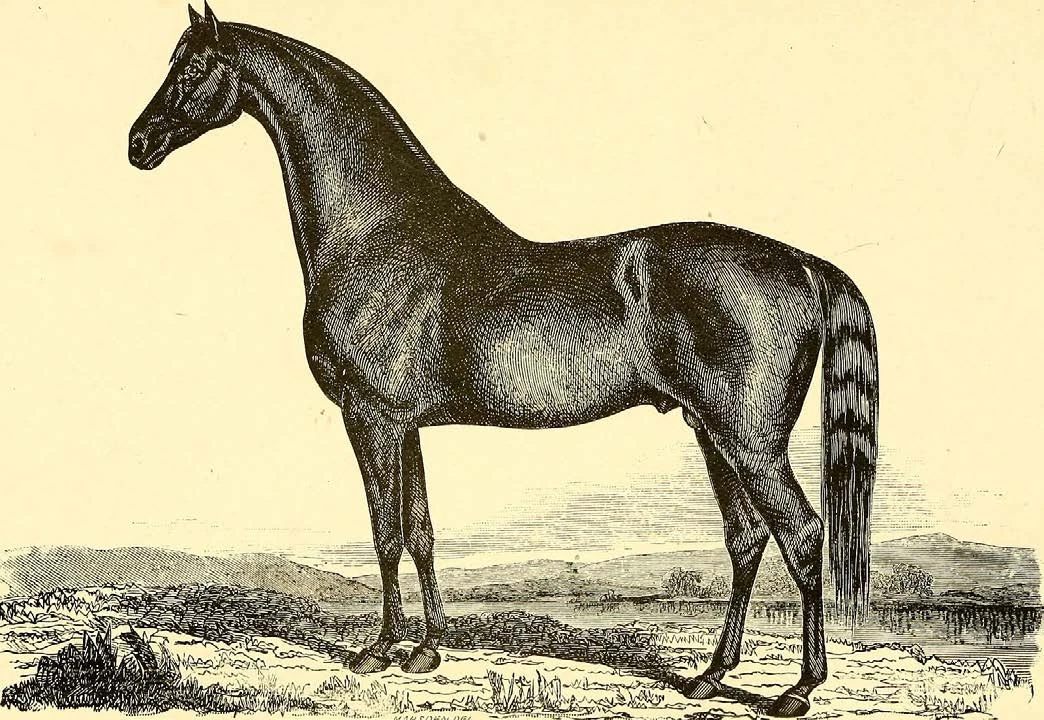
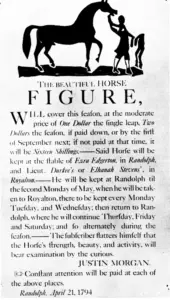
In 1792, possibly in payment of a debt, Morgan acquired the young stallion Figure (born in 1789), who was described in advertisements as a “beautiful bay horse” 15 hands to 15 hands three inches tall — despite a later legend that he was “diminutive.” Figure’s sire was probably True Briton, whom Morgan had kept at stud in 1785. Figure’s dam, whom Morgan had owned, was the daughter of Diamond, a stallion Morgan had advertised at stud in 1783.
Figure had been at stud in Hartford, Connecticut, in May 1792 before Morgan saw him. Morgan probably acquired Figure in Hartford in late May 1792 and took him to Vermont in June. In 1793 through 1795, Morgan advertised his stallion in several newspapers. Before April 1796, however, he sold Figure, who was advertised that year by another man. Perhaps conscious of his declining health, Morgan sold the horse to acquire land for his children.
Morgan died on March 22, 1798, in Randolph, possibly of a lung ailment, and his estate included no horse.
Figure long outlived Morgan and passed through several other owners. Figure won a race and a pulling bee and did various kinds of farm work and hauling. He also was at stud for several other seasons. He died in 1821 after an injury at age 32.
Culture Wars and Conflicting Information
And what happened to Morgan’s music? Starting in about 1810, “Culture with a capital C invaded America,” and any European composition (even a mediocre one) was considered far superior to any American composition. People began to make fun of the earlier American music, and it eventually fell completely out of vogue. The ironclad dominance of European standards persisted into the twentieth century, generally delaying the development of distinctive American music for more than a century.
By the mid-twentieth century, however, some music historians and other people began to realize how good the compositions of Morgan and his contemporaries are. One of Morgan’s works, “Amanda,” inspired a 1944 composition, “Fantasy on a Hymn Tune by Justin Morgan,” by Thomas Canning (1911–1949) — and that is the piece I heard on the radio.
Since the mid-nineteenth century, much has been written about Justin Morgan and his famous horse (who was later sometimes called Justin Morgan rather than Figure). Some of the sources of information, even from Morgan’s descendants, are conflicting. Highly fictionalized accounts have been published, including a 1945 children’s novel and a 1972 Disney film based on it.
Double Legacy
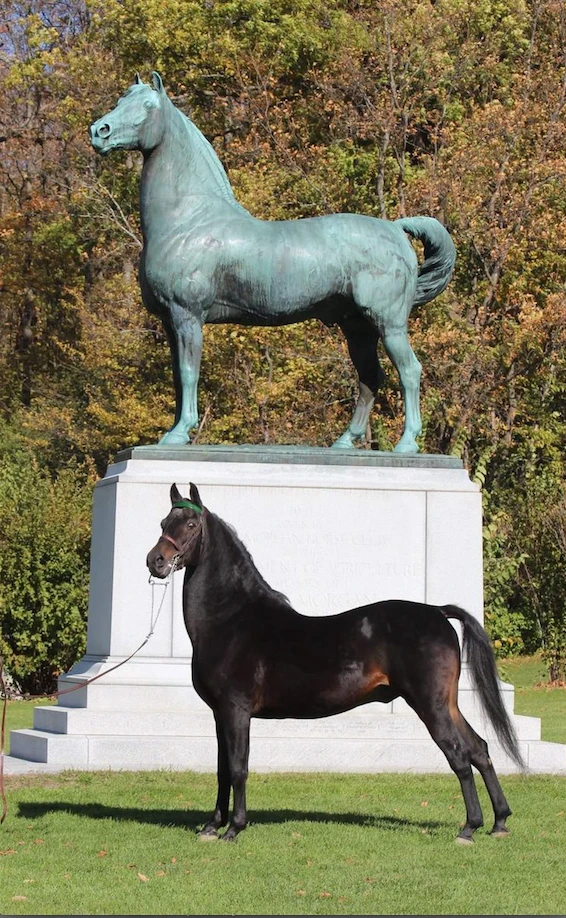
Figure was used extensively as a breeding stallion, but records are known to exist for only six of his sons. Three of them became notable as foundation stock for the Morgan breed — Woodbury, Bulrush, and Sherman. In the nineteenth century, Morgan horses were used for riding, pulling coaches, harness racing, light driving work, mining, and cavalry on both sides of the Civil War.
The worldwide population of Morgan horses was estimated to be more than 175,000 by the early twentieth century. Figure’s many descendants are considered “as American as Yankee Doodle,” hardy, adaptable, brave, intelligent, and versatile. Morgan horses are used in English and western riding and other disciplines.
The Morgan horse is a prize catch more than 230 years after Justin Morgan acquired his stallion Figure.
And Morgan’s music — also still prized for its richness, originality, and beauty — is a testament to his own versatility, skill, and perseverance.
Sidebar
Morgan Horse Show
October 4–11
The Grand National & World Championship Morgan Horse Show will be held at State Fair Park in Oklahoma City on October 4–11, 2025. Three shows will be held daily.
The American Morgan Horse Association and the Morgan Horse Foundation cooperate in the annual production of the show. A portion of the sponsorships is used as a charitable donation to provide scholarships, educational opportunities, public awareness, youth activities, and a forum to exhibit Morgan horses.
For more information, go to www.morganhorse.com.