by Carol Mowdy Bond
Cowboy. That globally known word is forever linked with the United States
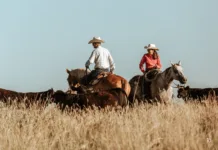
and westward expansion. Cowboy life, which has merged with cowboy legend, remains an integral part of American society. And cowboys on horseback are still a critical part of keeping the American food chain humming in the twenty-first century.
The Spanish arrived in the Americas during the early sixteenth century. They built ranches to raise livestock. The word vaqueros, which refers to Mexico’s native cowboys, came from the Spanish word vaca, meaning “cow.” Ranchers hired vaqueros to work livestock because they
were known for their outstanding roping, riding, and herding skills.
During the U.S. colonial era, there were cattle-raising societies in Massachusetts, the Carolinas, Florida, Georgia, and Alabama.
When settlers migrated into the western frontier in the 1800s, they embraced parts of the vaquero culture, including dress and methods. But American cowboys had diverse backgrounds and included not only eastern U.S. settlers and Europeans but also Native Americans, Mexicans, and African-Americans.
Cattle were wild in Texas, and they had few natural enemies. Historians estimate
that by the end of the Civil War, five million cattle roamed Texas. That was a catalyst for the 20-year golden age of the cowboy, from 1866 to 1886, when cattle drives and the range-cattle industry became an important part of American life. In 1866 alone, buckaroos drove more than a quarter of a million head of cattle north from Texas along trails through Indian Territory (the future Oklahoma) to Kansas railheads. Railroads then transported the beeves throughout the United States to the mushrooming American population.
Old West cattle drives inspired some of American fiction’s greatest works and entertainers. From Larry McMurtry’s pen to actors Audie Murphy, Roy Rogers, John Wayne, Robert Duvall, and others, the list of the entertainment industry’s cowboy contributions to the American psyche is endless. And those concepts are integrated into every aspect of American society.
A Crowning Achievement
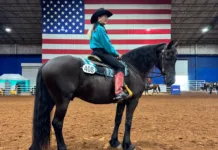
The cowboy hat symbolizes cowboy culture and is known around the world. It remains a critical, functional wardrobe piece for today’s cowboys and rodeo competitors, and it has spilled into the U.S. fashion and entertainment genres. Prior to its invention, cowpunchers wore whatever hats they owned.
What is known today as the cowboy hat evolved from Mexican sombreros, farm and plantation workers’ wide-brimmed hats, and U.S. cavalry hats. The wide brim protects from sun and rain and serves other purposes too.
Historians credit John B. Stetson with designing and marketing the first official U.S. cowboy hat in 1862. Stetson called that type of hat the “Boss of the Plains,” and it was first sold in Central City, Colorado, in 1865. The style served as a prototype for future designs.
However, studies show that perhaps the Stetson design originated at Christy’s hat factory in Frampton Cotterell, Bristol,
England. The 10-gallon hat, invented at the factory, became a source of contention. J.B. Stetson fought Christy’s for the patent but lost the case. However, Stetson won in the end because that hat style is universally known today as a Stetson, and few people are aware of Christy’s role.
Whether you are riding the range, the stockyards, or the rodeo circuit or going in for the latest Old West fashion experience, experts claim there are ways to choose the cowboy hat that looks best. At the place where the brim starts to curve up on the sides, the point should line up with the arch of the wearer’s eyebrows.
Styles of cowboy hats include Cattleman, Pinch Front, Diamond, Mountie, Gambler, and of course, Boss of the Plains.
The anatomy of the cowboy hat includes the crease (the indentation on the crown); the crown (the top of the hat that covers the head); the pinch (the shape of the crease, which varies by style); the band, or ribbon (a strip of cloth or other material that wraps around the seam where the crown meets the brim); and the brim (the part that extends out along the circumference of the hat).
Male actors aren’t the only ones who have moved the cowboy hat into the American mainstream. Actresses have played a great role in the story of the cowboy hat.
Just a few examples include Elizabeth Taylor, who donned a cowboy hat in the 1956 film Giant. Audrey Hepburn wore a Stetson in the 1959 movie Green Mansions. Marilyn Monroe rocked her hat in the 1961 film The Misfits. In the 1973 movie The Train Robbers, Ann-Margret’s cowboy hat was memorably fabulous.
Sharon Stone’s cowboy hat was critical to her role in the 1995 movie The Quick and the Dead. Sandra Bullock’s cowboy hat was a crucial wardrobe piece in her boot-scootin’ scene with Harry Connick Jr. in the 1998 movie Hope Floats. And in the 2010 remake of True Grit, Hailee Steinfeld wore a Stetson in her reprisal of Mattie Ross, alongside Jeff Bridges as lawman Rooster Cogburn.
Sporting Special Scarves
Then there’s the cowboy scarf, also known as a bandanna or kerchief. The most common color was red, and the kerchief was usually folded into a triangle and tied around the neck with a knot in the back. Cowboys couldn’t have lived without bandannas. They used them as masks to protect from dust and dirt that cattle kicked into the air. Bandannas made great earmuffs in cold weather and protected necks from sunburn. Used as pot holders when cowboys were cooking or using branding irons, bandannas were utility pieces that were necessities for everyday life.
So where did the paisley fabric design of cowboy bandannas come from? Cowboys who needed kerchiefs bought squares of cloth from stores where merchants sold fabric on bolts. Initially, striped fabric was available. Paisley fabric originated in Persia and India thousands of years prior to entry into Europe in the late 1700s. Eventually, people in Paisley, Scotland, made so many shawls of that fabric that the design nabbed the name of the place. Paisley fabric apparently became available for cowboys by the early twentieth century.
Bandannas are still essential for cowboys and cowgirls. But their U.S. history and narrative are truly amazing. It appears that the story even includes Martha Washington. Moving forward during the twentieth century, bandannas made their way into pop culture partly through various fictional characters, including Snow White and Rosie the Riveter. Even “The Boss,” Bruce Springsteen, sported red bandannas. And country singer Willie Nelson’s bandannas have been immortalized in two institutions, including the Smithsonian.