by Sharon Bishop-Baldwin
Oklahoma State University is preparing to break ground on a $329 million state-of-the-art veterinary teaching hospital in Stillwater, a project leaders say will have positive ripple effects across the state.
The new facility is expected to elevate care for both livestock and beloved companion animals while helping OSU’s College of Veterinary Medicine strengthen its national reputation.
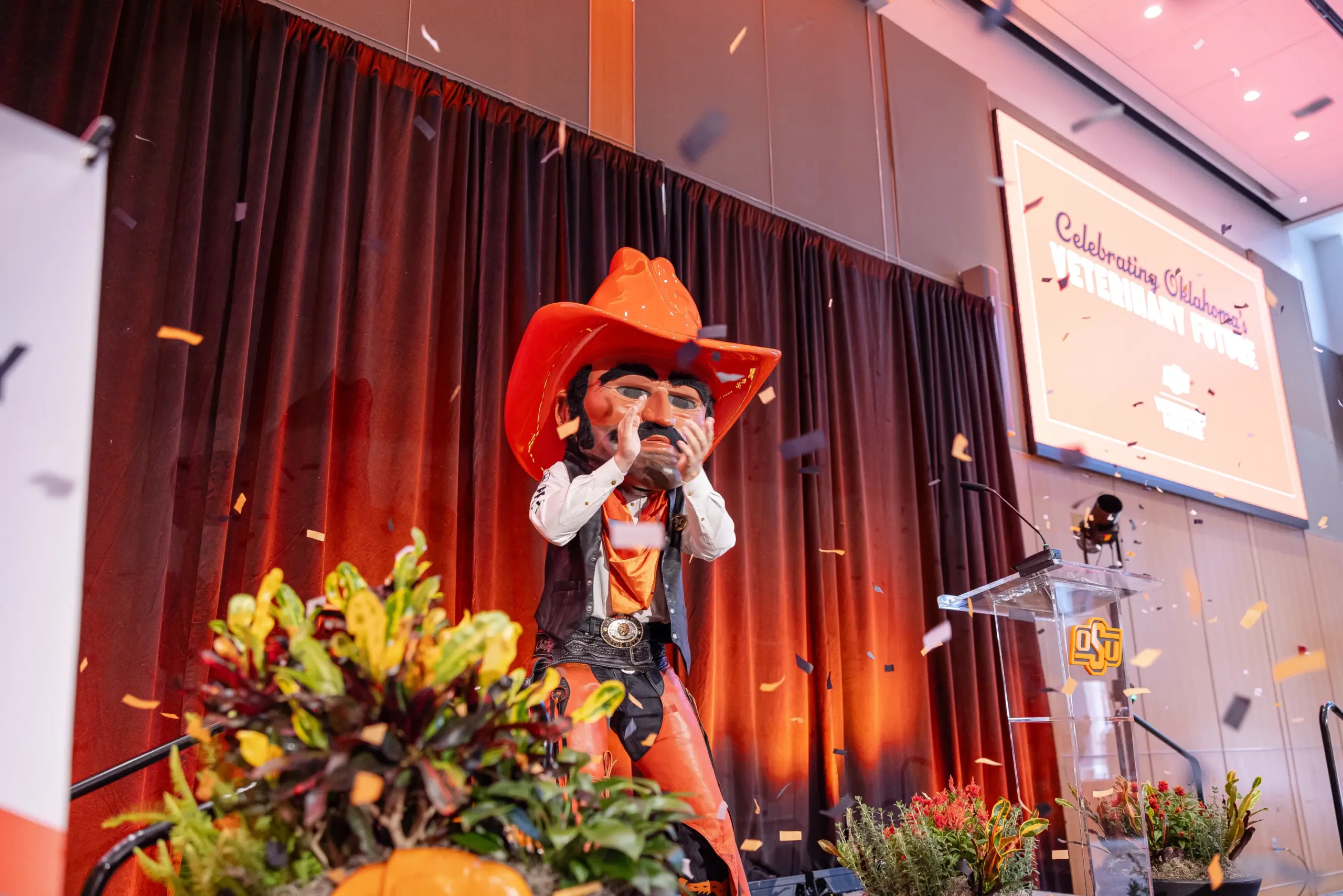
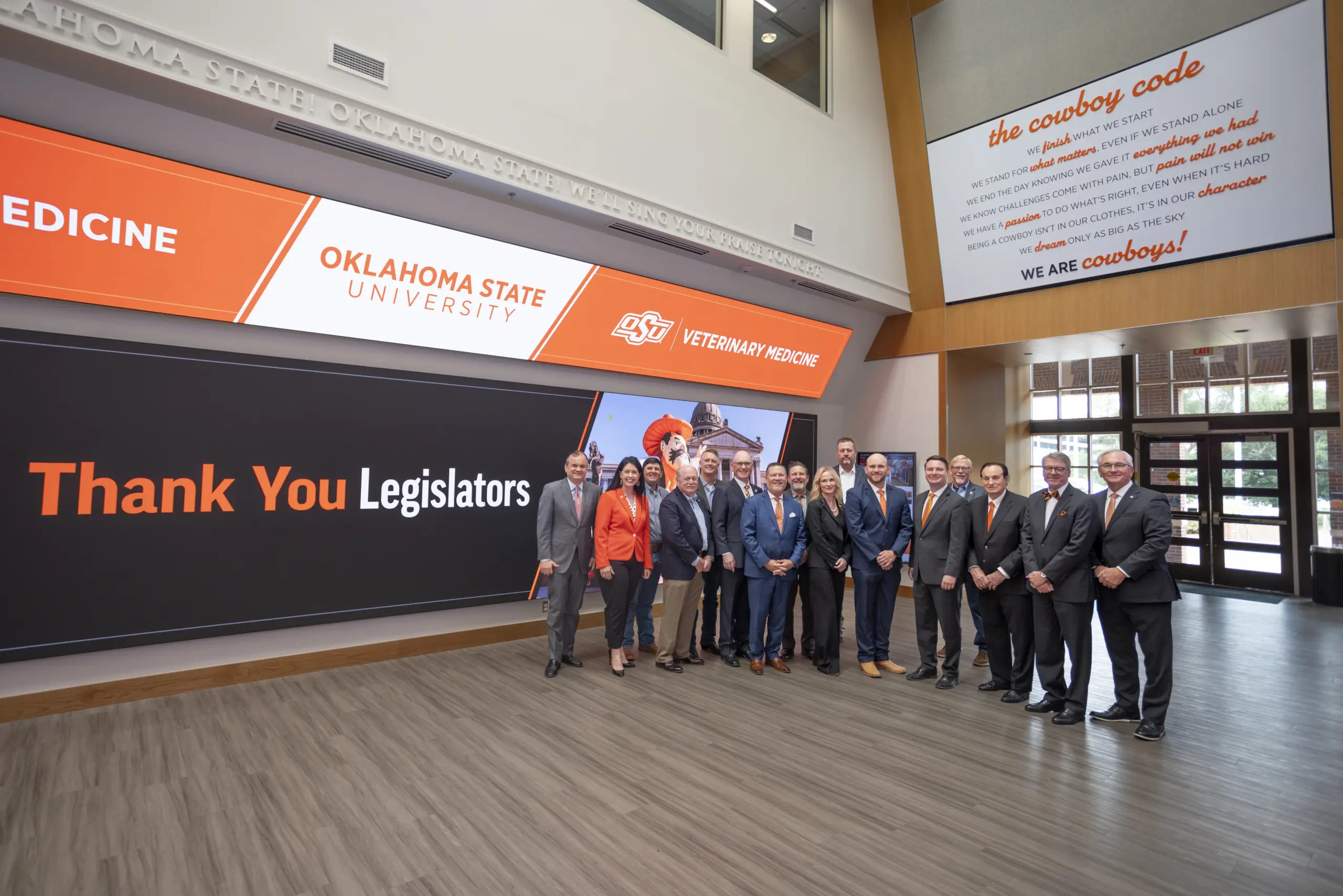
Attendees gathered in a large ballroom in the ConocoPhillips OSU Alumni Center on the OSU campus, along with a cadre of state lawmakers, state and OSU education leaders, and even Pistol Pete, to celebrate the announcement of the plan.
OSU — established as a land-grant university in 1890 as Oklahoma Agricultural and Mechanical College — has a legacy as a leader in veterinary medicine education, but that reputation has been challenged in recent years, as the university’s longtime facilities struggled to keep pace with modern demands. In 2017, the American Veterinary Medical Association placed the program on probation, sparking renewed commitment to reinvest in veterinary education.
OSU President Jim Hess, who recalled “shoveling stalls” in the College of Veterinary Medicine as a work-study student when he arrived on campus 50 years ago, said the new hospital will put those worries to rest. The project will be funded through a $250 million appropriation from the state Legislature this year and a $79 million allocation approved in 2023.
He referred to one of OSU’s chief rivals in the vet-med field, telling the crowd, “My goal is to put Texas A&M to shame.”
Hess said OSU officials toured several other vet-med schools, including those at Texas A&M, Kansas State and Auburn universities, as part of the effort to design the new hospital.
“We do try to pay attention to what our other land-grant partners are doing because we are competing,” he said, noting that the country has fewer than three dozen veterinary medicine schools.
Hess said OSU admits 106 students into its vet-med program each year. Upgraded facilities and an expanded faculty will allow the university to ask the American Veterinary Medical Association, its accrediting body, to admit more students.
And a new annual recurring appropriation of $1.2 million from the state Legislature will ease the financial burden on those students, he noted. The funding will provide scholarships or loan forgiveness for current or previous students who commit to practicing primarily large-animal or food-animal medicine in Oklahoma’s rural areas of 25,000 or fewer residents.
Leaders originally had hoped to spend far less money on a renovation of OSU’s existing veterinary hospital, but Hess said that idea quickly became unfeasible. They ultimately determined that a fresh start would bring the greatest long-term impact.
“We got about halfway through the planning process, and we realized that building was just not going to be able to support what we needed to do,” he said. “We were going to spend a ton of money, and nobody would ever notice that we’d spent it because it was all going to be infrastructure.”
The new 255,000-square-foot hospital will replace the existing 145,376-square-foot one, built nearly half a century ago to accommodate 60 students but which now supports more than 150. However, the existing facilities aren’t going away; they will be used for pre-clinical training and classroom education.
Construction of the new hospital, which probably will consist of more than one building, will start in the spring and is expected to take about 30 months to complete, he said. GH2 Architects is designing the new hospital, and Manhattan Construction is the construction manager.
While the final site is still being determined, Hess said the choice has been narrowed to two highly visible campus locations.
“One of them is my favorite because it’s in a highly visible place where people will drive by it every day,” he said, adding that he wants the hospital “to be a gateway” to the university.
The facility will likely segregate small-animal and large-animal work but will include publicly available emergency rooms for both, as well as an equine surgery unit.
Of the $329 million total, Hess estimated that about $50 million will be spent on high-tech equipment, such as MRI and CT apparatuses.
That’s music to the ears of Dr. Sue Hurst, a 1996 graduate of OSU’s College of Veterinary Medicine and the founder of Kindness Animal Hospital in south Tulsa.
“Without a vet school, we would have no vets in Oklahoma. The fact that they’re doing something to save the vet school is fantastic,” Hurst said.
For alumni and practicing veterinarians like Hurst, the investment brings more than a new building — it represents a new era for the veterinary profession in Oklahoma.
“This will be great,” she added. “This will put better care much closer to us.”